Please be aware of our copyright notice. If you have a good reaon for using a photo from this site ask permission from first - it is frequently given.
London and South Western Railway Luggage Labels
The Isle of Wight
|
by Mike Morant As ever, within our generic hobby of railway interests, the Isle of Wight is being viewed and treated as a special case and with good reason where luggage labels are concerned. It should be borne in mind that both the LSWR and LBSCR had vested interests in the Island mainly in the form of trafficking tourists between there and the mainland. This text isn't being presented as a potted railway history but it is worth mentioning that both railways had early aspirations to access the island via Portsmouth and Ryde even though the facilities at the the latter were hopelessy inadequate. The issue was complicated somewhat where joint agreement was concerned between the two companies by the fact that the LSWR also had island access via its facility at Stoke's Bay which the LBSCR resented. Not only was there that long-running dispute but there was also one on the island itself over the Ryde Pier Tramway, a horsedrawn service from St.John's Road to an inadequate pier facility to the east of the one we know today. The IoWR's Ryde terminus was at St. John's Road and subsequent entry to Esplanade and the new Pier Head stations were by the use of running powers over the joint LSWR/LBSCR line. As hinted at above, the mainland companies tired of the island politics and obtained an Act of Parliament to construct a modern pier facility with a station and the intermediate one at Esplanade together with the tunnel between there and St. John's Road station. The story doesn't end there as the LSWR later used its facilities at both Southampton and Lymington to gain access to the island as well as accessing it via Cowes instead of Ryde. The LBSCR, in the end, had to be content with just the Portsmouth to Ryde service. Coloured labels (other than mauve)
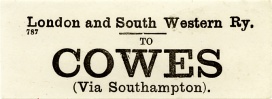
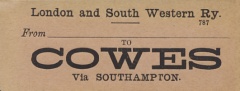
Two examples from the above table of coloured labels (other than mauve) to Isle of Wight destinations. White labelsThe type with a From line yields but two examples:
The type without a From line yields six examples:
All three of the white examples displayed here are from the 'no from line' assortment. Mauve labelsThese labels, generally regarded as scarce with but a few exceptions, are highly sought after. The principle reason for their scarcity is their inherent physical weakness. The fact that they are prone to dessication has already been mentioned and just about every collector of this label type has a story to tell about the way they can crumble before one's very eyes unless they are handled with the greatest care and concentration. Tweezers rather than fingers are the order of the day. It should be borne in mind that IoW labels are acquired by collectors, not just of luggage labels, but also in the context of anything relating to the island's transport system. This factor has also contributed to a general shortage of the genre It's worth pointing out here that these labels, particularly those from Waterloo, are remarkable survivors as they were still extant in the label racks at Waterloo station in the late 1950's to which this writer can attest as some in his own collection were acquired directly from that source. The remarkable aspect is that many of them are via Stokes Bay which closed to traffic in 1915 and yet they stayed in situ for all those years. The labels themselves fall into the same categories as the white labels detailed elsewhere but they were printed on what is now mainly mauve paper although the clener examples suggest that the original colour was quite a rich purple. The majority of the survivors have faded badly and have turned to a brownish biscuit colour at the edges. That is, if there are any complete edges. All the islands's stations are named on this group of labels plus Alum Bay and Totland Bay but what excites greater interest is the diversity of routings stated on them:
Below are some examples of these somewhat quirky labels but note that they have been slightly reduced in size for display purposes. They are, in reality, the same size as their white cousins:
One might be forgiven for thinking that the Isle of Wight has received enough attention but its labels story doesn't quite end with the mauve ones as there are three more types to consider. The red cross varietiesAt a late stage in the development of its luggage labels the LSWR followed (or agreed with) a trend set by its IoW partner, the LBSCR which had applied a red diagonal cross to its IoW destination labels. The LBSCR did this extensively but the LSWR didn't fully adopt the style with the result that the assortment is very small and some of them are very scarce. As usual, they all have the '787' code on the right-hand side but it is always suffixed with an upper case 'B'.
There is a final pair of red cross types that are distinctive for the fact that they are a different proportional size from all other LSWR labels described hitherto. They are slightly narrower in width and distinctly taller.
This page was last updated 7 July 2007 |
|||||||||||||||||||||||||||||||||||||||||||||||||||||||||||||||||||||||||||||||||||||||||||||||||||||||




.jpg)
.jpg)
 >
>


 The most commonly available of the red crosses is this one which
is identical to the other white labels from Waterloo (in the centre) but has a
red cross applied to it.
The most commonly available of the red crosses is this one which
is identical to the other white labels from Waterloo (in the centre) but has a
red cross applied to it. There are two groups, that from Waterloo with just the one
example to Brading and a set of nine without a From line to Bembridge,
Brading, all three Ryde stations, Sandown, Shanklin, Ventnor and Yarmouth.
There are two groups, that from Waterloo with just the one
example to Brading and a set of nine without a From line to Bembridge,
Brading, all three Ryde stations, Sandown, Shanklin, Ventnor and Yarmouth.Index to Labels pages