Please be aware of our copyright notice. If you have a good reaon for using a photo from this site ask permission from first - it is frequently given.
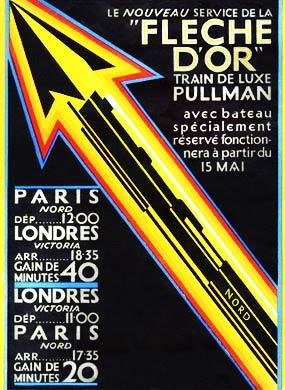
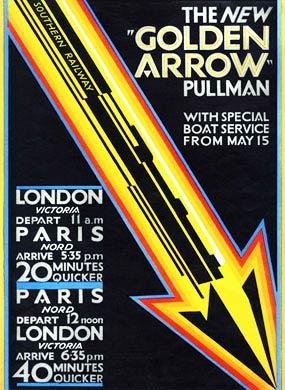
A matching pair of Southern Railway advertisements for the "Golden Arrow" service, one in French and the other in English.
Reproduced by kind permission of Southern Posters - classic railway art.
The origins of the "Golden Arrow" go back to 1882 when the LC&DR launched their "Dover Continental Pullman Car Boat Express" between Victoria and Dover, using a borrowed LB&SCR first class Pullman car. The train didn't do very well, though, and the Pullman car was returned to the LB&SCR a couple of years later. From 1910 the SE&CR included Pullman cars in their boat trains, though without any particular name being applied. Pullman travel, however, was now firmly established as the only way to travel for those who could afford it and shortly after the formation of the Southern Railway an all-Pullman relief to the 11:00 am boat train was run at 10:45am, with a corresponding train running in the opposite direction. From the summer of 1929 this train gained its prestigious name of "Golden Arrow"
Passengers would travel by ferry from Dover or Folkestone to Calais where they boarded a similarly prestigious French train formed from Compagnie Internationale des Wagon Lits coaches under the French name Flêche d' Or.
After the end of the war the "Golden Arrow" returned on 15th April 1946 (following a Press Run on the 13th) and continued to work Dover-Calais until the end of the 1952 summer timetable.

A closer view of the one of the Arrows (this one on 21C1) that were fixed to the side casing of the "Golden Arrow" locomotives, in this case Nº21C1 Channel Packet.
photograph: Graham Muspratt collection
Not only did the passengers enjoy first class travel on the railway, they also had the pleasure of a first class only ferry, the Canterbury, that was built by the SR expressly for this purpose. The "Golden Arrow" left Victoria at 11:00 am, arriving Dover at 12:30 pm after which the Canterbury sailed at 12:55 pm, berthing in Calais at 2:10 pm. Customs and Passport controls were handled on board ship so that the final stretch of the journey, on the Flêche d' Or, was able to start at 2:25 pm, arriving at the Gare du Nord at 5:35 pm.
In the reverse direction passengers left the Gare du Nord at 12:00 noon, arrived at Calais at 3:10 pm, sailed at 3:25 pm, arriving at Dover at 4:40 pm. Customs and Passport controls were at the dock in this direction, but even so the train was booked to leave Dover just 17 minutes later for a more leisurely journey to Victoria, arriving at 6:35 pm.

Merchant Navy class Nº21C1 Channel Packet is ready to work the Press Run for the inauguration of the post war "Golden Arrow" on 13th April 1946.
photographs: Graham Muspratt collection
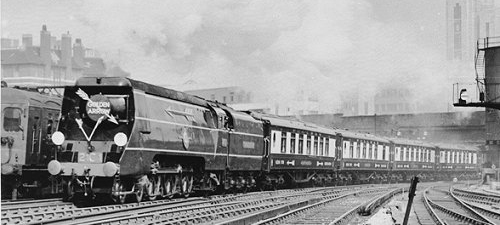
21C1 storming out of Victoria station with the Press Run for the inauguration of the post war "Golden Arrow" on 13th April 1946.
photograph: Graham Muspratt collection
Ten all-new Pullmans were built from 1949 and entered service as the "Festival of Britain Golden Arrow" on 11th June 1951. For the winter timetable 1952/3 the SNCF claimed there was no justification for staffing two trains and, as on the English side, wanted to use the same train in both directions. This resulted in the train leaving Victoria at 2:00 pm (1:00 pm when French and British time were an hour different) from September 1952, travelling via Folkestone and not reaching Paris until 9:40pm. The steamer crossed the Channel from Folkestone to Calais in order to connect with the train from Calais to Basle and beyond. The return journey was different, leaving Paris at 12:45 pm for Calais the passengers then crossed the Channel to Dover, eventually arriving at Victoria at 7:45 pm (or 6:45 pm). Journey times were now longer than they had been in 1929 and passenger numbers were falling off, with the train now including up to seven Pullman cars plus ordinary stock, though from 1960 the Victoria departure time was restored to 11:00 am. All good things come to an end, however, and the last "Golden Arrow" ran on 30th September 1972.

Probably one of the most famous trains of all time, the "Golden Arrow" waits for departure time at Victoria station in the charge of Bulleid Merchant Navy class pacific 35027 Port Line carrying the experimental blue livery that was applied to Class 8 locomotives in the early British Railways days.
photograph: Roy Vandersteen collection
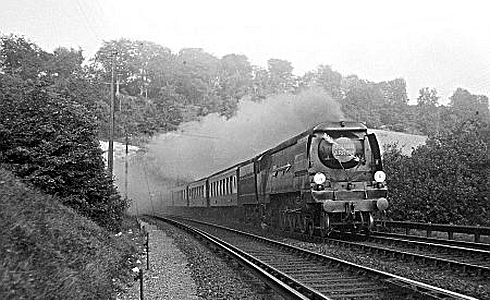
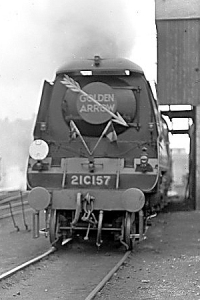
Sometime during 1947 un-named Bulleid light pacific 21C157 (later to become Biggin Hill) is made ready at Stewarts Lane to work the "Golden Arrow" and unidentified light pacific working the "Golden Arrow" in early British Railways days.
photographs: Mike Morant collection
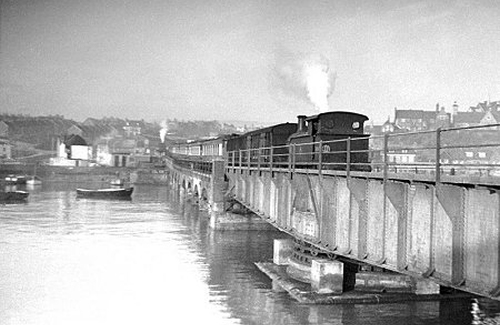
For the last part of the journey to Folkestone the "Golden Arrow" engine would come off the train and hand it over to two or three tank engines who would take it on the last part of the journey to the Harbour station. Here a Stirling R1 0-6-0 tank, believed to be 31047, is at the head of the train whilst at the rear are almost certainly two more similar engines providing the braking effort for descending this fairly steep bank. When the train leaves Folkestone Harbour all three will be required to lift the weight of the train up the bank again.
photograph by Mike Morant
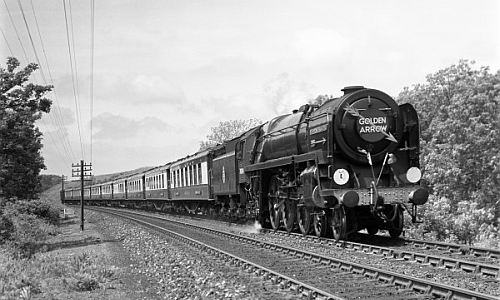
"Britannia" class Nº70004 William Shakespeare working a "Golden Arrow" duty, date believed to be during 1951, was photographed at Sandling Shorncliffe.
photograph by Mike Morant
Before WWII the "Golden Arrow" was worked almost exclusively by Lord Nelson class locos, with a very occasional King Arthur. For the resurrected service the first locomotive used was 21C1 Channel Packet, though from 1946 a Bulleid light pacific was the usual motive power with, for a while in the 1950s, BR Standard Class 7 70004 William Shakespeare. When this loco was transferred to the London Midland Region the light pacifics returned to the duty, only to be replaced after electrification by electric locomotives, the first electic hauled service being by E5015 on 12st June 1961. When the rail blue era arrived, the Pullmans lost their distinctive livery in favour of the new BR blue and grey, although there were two different colour schemes used, one as with the "Brighton Belle" "Corporate" livery and the other reversed, with the main body colour grey with dark blue to the window area, making them look somewhat continental. At least one (Car Nº208) was repainted thus sometime between 1964 and 1967 whilst the others were repainted by 1969, either in the Grey and Blue of Car Nº208 (believed to have been three cars in total) or the Blue and Grey "Corporate" livery. Also by 1969 the cars were no longer known by their by their names, simply by their stock numbers.
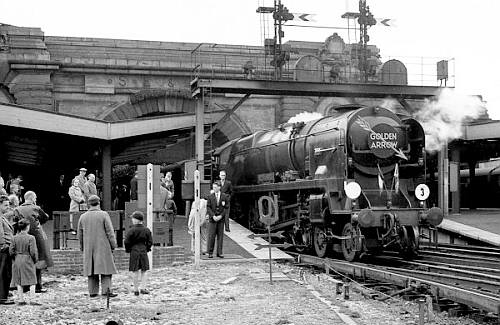
Finally steam gave way to electric traction. On the very last day of steam working, 11th June 1961, the honours fell to modified Bulleid pacific Nº34100 Appledore to haul the last steam-hauled working.
photograph: Mike Morant collection
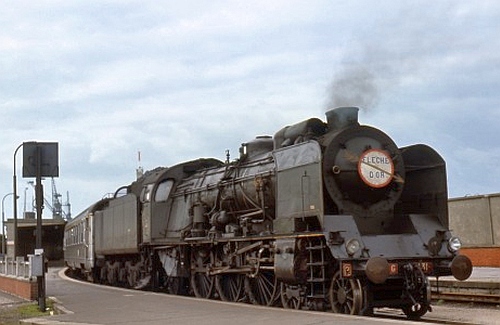
Steam lasted longer on the other side of the Channel where the motive power was provided by SNCF. Here is 231G Pacific Nº231G131 leaving Calais Maritime with the Flèche d'Or for Paris on 15th September 1966.
photograph: Gerald T. Robinson/Mike Morant collection
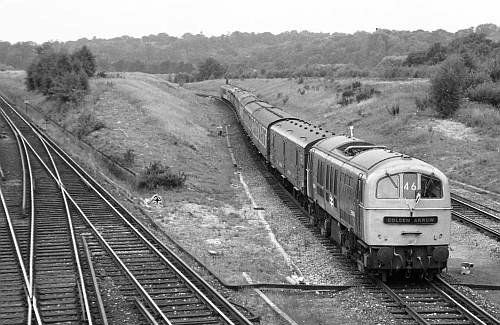
In this photograph type HA electric locomotive E5007 locomotive was photographed hauling the "Golden Arrow" at Petts Wood on 27th July 1968.
photograph: Mike Morant collection
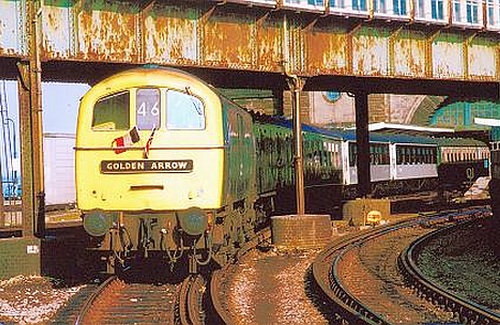
This photograph of the "Golden Arrow" at Dover Marine station on 21st June 1969 is the only one we have showing Pullman cars in the 'reverse livery'. The second vehicle is a 'normal livery' blue/grey Pullman car but it is impossible to tell which cars these are. We do, however, know the locomotive is E5006!
photograph by David Pool
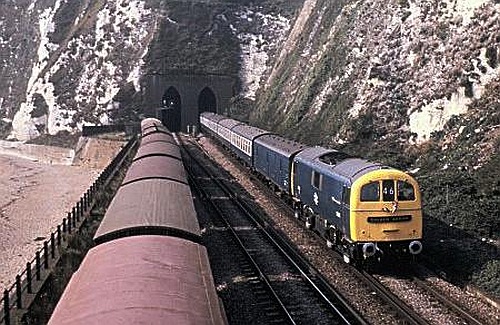
In this photograph E5013 heads the very last down "Golden Arrow" on 30th September 1972. The same loco also worked the last up service. Note the number of ordinary coaches in the train, the few remaining Pullman coaches are still in the tunnel!
photograph by Chris Ralls
"Golden Arrow" timing Victoria - Folkestone and Dover - Victoria winter 1959/60 |
|||
| pm | pm | ||
| Victoria dep: | 1.00 | Dover Marine dep: | 5.13 |
| Herne Hill pass: | 1:08½ | Ashford pass: | 5:39½ |
| Beckenham Junc pass: | 1.16 | Paddock Wood pass: | 5.57½ |
| Bickley Junc pass: | 1.22 | Tonbridge pass: | 6.02½ |
| Orpington pass: | 1.26 | Sevenoaks pass: | 6:14½ |
| Sevenoaks pass: | 1:36½ | Orpington pass: | 6.22 |
| Tonbridge pass: | 1.44½ | Bickley Junc pass: | 6:25½ |
| Paddock Wood pass: | 1.50 | Beckenham Junc pass: | 6:31 |
| Ashford pass: | 2.09½ | Herne Hill pass: | 6:38 |
| Folkestone Junc arr: | 2.26 | Victoria arr: | 6:45 |
| Folkestone Harbour arr: | 2:38 | ||
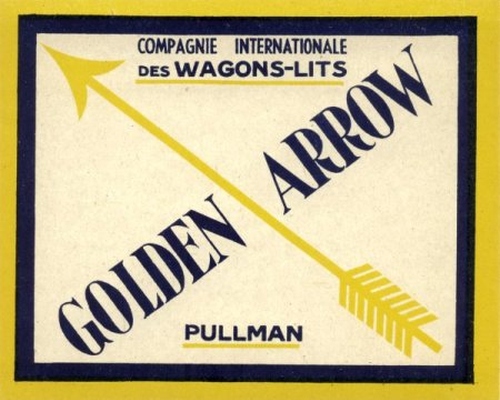
One of the special labels that were used for Golden Arrow luggage.
image by Mike Morant
With thanks to Glen Woods who provided much of the above information on the Pullman Cars. Thanks also to Glen we have details of the various Pullman Cars that were allocated to the Golden Arrow service on various dates during its post-war years, but it should be noted that not all the allocated cars were used on any given day and, indeed, other cars were used as short term replacements (especially as a replacement for the "Trianon Bar" when either Myrtle or Grosvenor were used).
Notes:
(5) Post WWII a number of Pullman Cars ran, temporarily, as Buffet Cars.
Trianon, although always a Pullman Buffet Car, was one of these and carried
the number 5.
(S 36) & (S 38) Second class with 36 or 38 seats.
(T 36) & (T 42) Third class with 36 or 42 seats.
(N) New-build Pullman cars entering service 11th June 1951.
| 16/6, 1/10/47 & 31/5/48 Adrian Cecelia Chloria Lady Dalziel Montana Niobe Onyx Sappho Trianon (5) Zenobia |
27/9/48 & 23/5/49 Adrian Cecelia Chloria Flora Juno Montana Onyx Sappho Trianon Zenobia |
23/5/49, 5/6 & 25/9/50 Adrian Cecelia Chloria Flora Juno Montana Onyx Sappho Trianon Zenobia Car Nº99 (S 38) Car Nº294 (S 36) |
18/6 & 10/9/51
Aquila (N) Carina (N) Cygnus (N) Hercules (N) Isle of Thanet Minerva (N) Orion (N) Pegasus (N) Perseus (N) Zena Car Nº34 (T 42) Car Nº35 (T 42) (N) Car Nº36 (T 42) Car Nº208 (T 36) (N) |
30/6 & 15/9/52
Aquila Aries Carina Cygnus Hercules Isle of Thanet Minerva Orion Pegasus Phoenix Zena Car Nº34 (T 42) Car Nº35 (T 42) Car Nº36 (T 42) Car Nº208 (T 36) |
8/6 & 21/9/53, 14/6 & 20/9/54 Aquila Aries Carina Cygnus Hercules Isle of Thanet Minerva Orion Pegasus Phoenix Car Nº34 (T 42) Car Nº35 (T 42) Car Nº36 (T 42) Car Nº208 (T 36) |
13/6 & 19/9/55, 11/6 & 17/9/56, 17/6 & 16/9/57, 9/6 & 15/9/58, 15/6 & 2/11/59, 13/6 & 12/9/60, 12/6 & 11/9/61 Aquila Aries Carina Cygnus Hercules Isle of Thanet Minerva Orion Pegasus Phoenix Car Nº34 (T 42) (S 42 from 11/6/56) Car Nº36 (T 42) (S 42 from 11/6/56) Car Nº208 (T 36) (S 36 from 11/6/56) |
18/6/62 & 7/6/63 Aquila Aries Carina Cygnus Hercules Isle of Thanet Minerva Orion Pegasus Perseus Phoenix Car Nº34 (S 42) Car Nº36 (S 42) Car Nº208 (S 36) |
15/6/64 Aquila Carina Hercules Isle of Thanet Minerva Orion Perseus Phoenix Car Nº34 (S 42) Car Nº36 (S 42) Car Nº208 (S 36) |
14/6/65 Aquila Carina Isle of Thanet Minerva Orion Phoenix Car Nº208 (S 36) |
13/6/66
Aquila Carina Cygnus Isle of Thanet Minerva Orion Phoenix Car Nº208 (S 36) |
|
| 10/7/67
Carina Cygnus Orion Perseus Phoenix Car Nº208 (S 36) |
During 1968 the following allocated cars were
converted as follows, and had their names replaced by their numbers: Carina (Nº307) Converted to 2 x 1 Seating (seating increased from 22 to 28) --- (Nº308) Converted to 2 x 1 Seating (seating increased from 26 to 32) Orion (Nº306) Converted to 2 x 1 Seating (seating increased from 22 to 28) Perseus (Nº301) Converted to 2 x 1 Seating (seating increased from 26 to 32) Phoenix (Nº302) Converted to 2 x 1 Seating (seating increased from 26 to 32) Car Nº208 (Reclassified First Class 36 seats) |
5/5/69, 4/5/70 3/5/71 & 1/5/72 301 302 306 307 308 |
|||
Index to Named trains