Waterloo
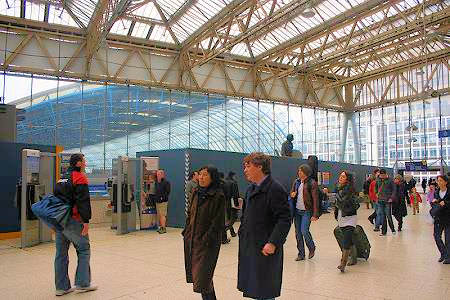
| Waterloo International Station closed on 13th November 2007 and
long term plans for its re-use are still under discussion. At least the current
economic situation is removing the pressure of converting it to a retail
development. At the time of this photograph hoardings obscure the view of the
former International low level concourse, unfortunately they also part-hide the
statue of famous railway artist Terrence Cuneo. Some retail units, to make up
for the loss along the barrier line, are being built here.
photograph by Colin Duff |
 |
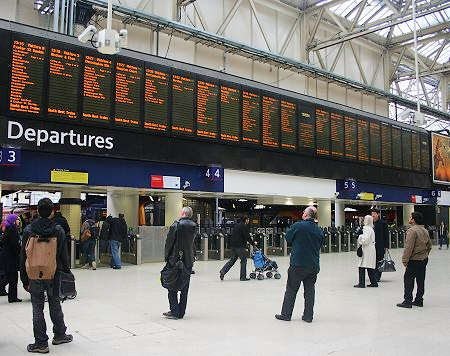 |
The photographer has known Waterloo Station for half a century
and nothing has stayed the same for very long as the station evolves to meet
changing needs. A visit on February 22nd 2009 revealed its latest
transformation. The arguably not fit for purpose plasma screen departure
displays at right angles to the barrier line have gone to be replaced by bright
LED displays where they belong - at the barrier line. Retail units along the
barrier line have gone to be replaced by automatic ticket gates and the trains
beyond can be seen - Waterloo is once again looking like a "proper"
station! The departure indicator board and ticket gates by the suburban line
platforms. The set of gates between platforms 1 and 11 came into use on 29th
December 2008.
photograph by Colin Duff |
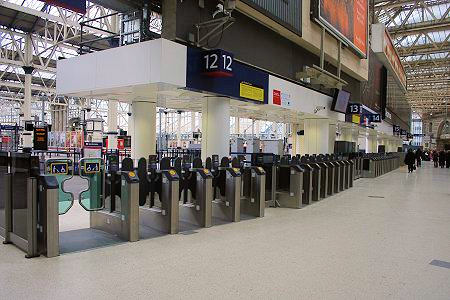
| Bright and airy, the almost continuous line of gates between
platforms 12 and 18 (at the time of this Sunday visit these platforms were not
in use due to engineering work). Eventually there will be 160 gates, the
largest set in Europe. In order that passenger flow in the subway under the
platforms is not adversely affected by use of gates an extensive circulating
area under the arches has been opened up to create a sufficient line of ticket
gates.
photograph by Colin Duff |
 |
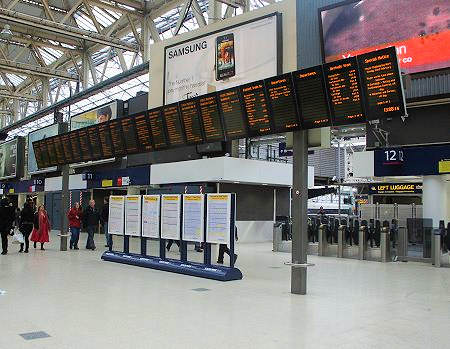 |
Between platforms 11 and 12 is a set of lower level customer
information displays . This was the location of the former not fit for purpose
plasma displays at right angles to this.
photograph by Colin Duff |
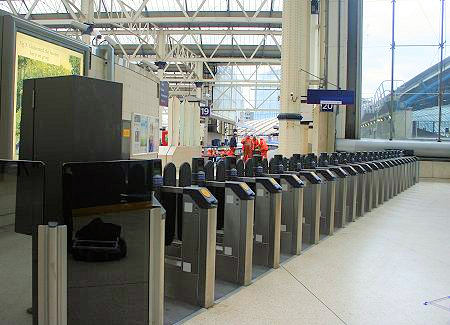
| The gates to and from platforms 19 and 20, the latter in the
former International Station will come into use once the two "cut
throughs" from platform 19, requiring steps and ramps due to the height
difference, have been completed. The site of the former International Station
was once the Windsor Line platforms - almost a station within a station. So the
clock is partially about to turn again. The automatic ticket gates are capable
of reading magnetic stripe paper tickets, ITSO smartcards and, once
negotiations have been completed, Oyster smartcards.
photograph by Colin Duff |
 |
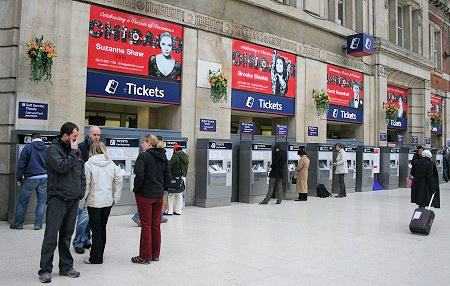 |
Now a slight retraction from the previous looking like a
"proper" station comment. A cynic might think that almost completely
obscuring the booking office with a line of ticket machines is a ploy to make
people think there isn't booking office! Whilst the latest generation of
ticket machines offer a greater number of ticket options, railcard discounts
and destinations than previously they do not offer all travel options nor do
they provide advice about the best choice of ticket.
photograph by Colin Duff |
| Finally no account of Waterloo is complete without even a brief mention of the other three Waterloo stations. Firstly that of the underground Waterloo and City Line, the line built by the LSWR to ply commuters between Waterloo and the City of London, now owned by the London Underground since privatisation. Secondly the main London Underground station serving the Bakerloo, Northern (and since late 1999) Jubilee lines. Finally the Necropolis station situated to the south of the main station beyond platform 1. This small two track station served the funeral trains of the Necropolis and National Mausoleum Company taking coffins and mourners from London to the company's cemetery at Brookwood in Surrey. The Necropolis station was destroyed in an air raid in April 1941. |
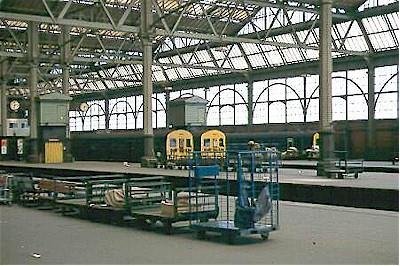
| A 1970 view within the trainshed looking east towards
platforms 5 to 1 (as seen in this angle). Three 4 Sub units, now a thing of the
past, are much in evidence.
photograph by Michael Taylor |
 |
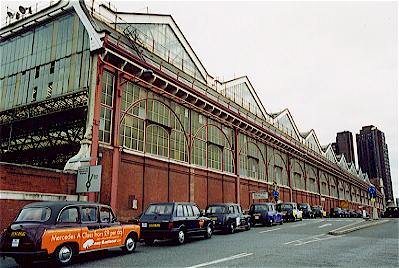 |
The other side of the trainshed east wall from the above picture, as
pictured on 17 May 2000. With the cab road relocated from the centre of the
platforms taxis for "domestic" passengers now queue around the east
and north sides of the station.
photograph by Colin Duff |
| An aerial panorama of the station taken in steam days. The
platforms nearest, outside the main canopy, have today gone to make way for the
Eurostar station.
photograph by the late Eric Arnold, courtesy of Mike Morant | 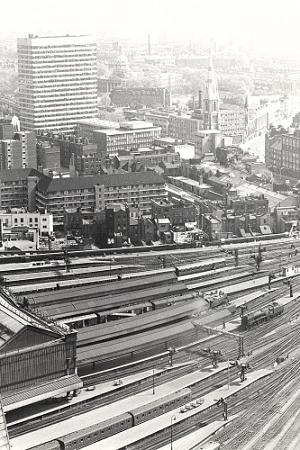 |
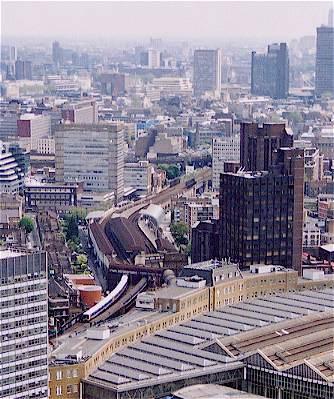 |
Another aerial view from the British Airways London Eye - this time of
Waterloo East Station. The former SER station is heavily hemmed in by buildings
and the line from Charing Cross to London Bridge traverses on a brick viaduct a heavily built up
part of the south bank area of London. In this 2nd June 2000 photograph a class
465 Networker unit and an unidentified MkI EMU can be seen.
photograph by Colin Duff |
| A further aerial view of the station (looking east) taken on
2 June 2000 from the British Airways London Eye. Note the two different styles
of the trainshed roofs and lengths of platforms where the Eurostar station
has replaced the platforms shown above.
photograph by Colin Duff | 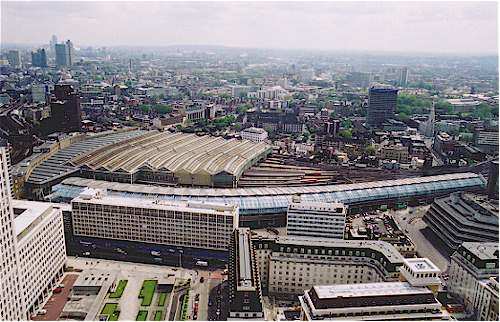 |
All photographs are copyright
return to picture gallery page
This page was created 13 March 2009