Waterloo
| The biggest development of the station to date began in November 1990 with the abolition of the north sidings and rolling stock lift to the Waterloo and City line, the building of new platforms in what was formerly the central cab road and demolition of the "Village" office block which separated the main and Windsor line platforms. This allowed Windsor line services to use the main station and for the Windsor line platforms to be demolished to make room for the new Waterloo International Station. The modernistic Waterloo International Station was officially opened 17th May 1993 and is the terminus for Eurostar services through the Channel Tunnel. |
 |
The Waterloo International concourse is at a level below that of the main
station, however the view from the main concourse towards the international
platforms is obscured. 30th January 2000.
photograph by Colin Duff> |
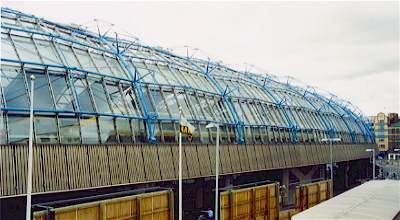
| The modernistic looking International Station trainshed -a
Eurostar unit can just be seen within. The interior is sheeted to protect from
flying glass as there is a glass shattering problem with the roof - currently
the subject of a legal dispute. 17th May 2000.
photograph by Colin Duff |
 |
| Today there are platform capacity problems in the station and South West Trains have launched plans to build a new pedestrian concourse at a high level and then lengthen the platforms into the existing concourse to permit trains of the same number of cars as present but of the newer 23 metre car length. This plan is hotly contested since it would spoil the looks of what is regarded by many as the most spacious and uncluttered terminus in London, and also that since the platform working of Waterloo has always been slacker than at other Southern termini capacity could be increased simply by more intensive working. |
 |
This and the following photograph show the interior of the Waterloo International train shed on 10th March 1996. |
|
photographs by John Lewis |
 |
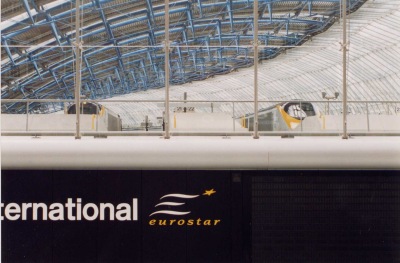 |
The International platforms at Waterloo as seen from the concourse of the
main station before the view was obscured by advertisements.
photograph by John Lewis |
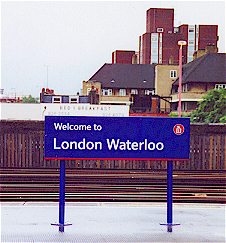
| During the spring and summer of 2000 new Railtrack corporate
image signs began appearing at major stations. The new signs in use at Waterloo
- this pictured on 16 September 2000 - feature a stylised lion emblem. The lion
has long been associated with Waterloo resulting from the famous stone lion
sculpture in the area.
photograph by Colin Duff |
 |
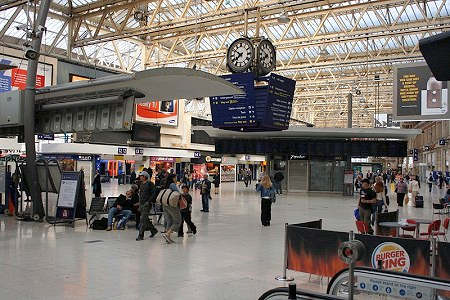 |
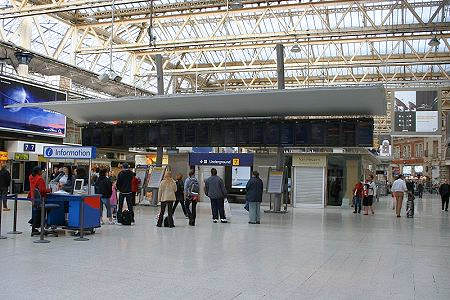
By 2005 the high level "flap" departures and arrivals
indicators above the barrier line had been placed by low level plasma displays
on the concourse at right angles to the barrier line. The plasma screens had
low contrast displays and required an awning over them to shield them from
light from the glazed roof. This was only partially successful and they were
difficult to read on a bright day. Nor could they be seen at a quick glance
when dashing across the concourse from the Underground to the platforms! Did
anyone study passenger habits before deciding to use plasma screens? Here are those between platforms 11 and 12. photograph by Colin Duff |
| Here are the screens for the suburban platforms, both this and
the above photographed on 11th June 2005.
photograph by Colin Duff |
 |
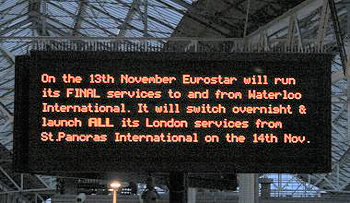
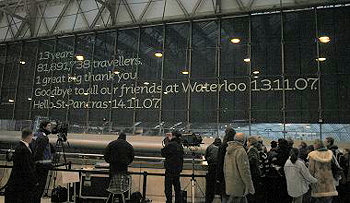
| Tuesday 13th November 2007 was the end of an era for both the Southern third
rail system and Eurostar when Eurostar operations ceased to use both
Waterloo International Station. Thirteen years to the day after the first
public Eurostar services in and out of Waterloo International their London
terminus switched to St. Pancras International and their British depot from
Old Oak Common, Acton, to Stratford. With the entire length of the Channel
Tunnel Rail Link, now branded as High Speed 1, in use Britain has now joined
the European High Speed trian network. The final day at Waterloo
International was celebrated with a blaze of publicity, entertainments and a
media circus.
photographs below by Colin Duff |
 |
 |
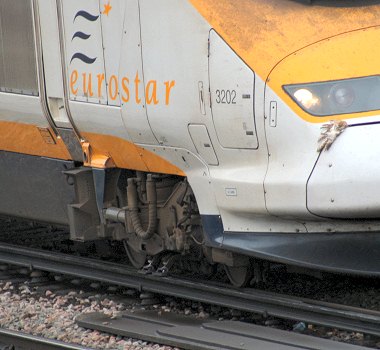 |
Tuesday 13th November 2007 was the end of an era for both the
Southern third rail system and Eurostar when Eurostar operations ceased to use
D.C. conductor rail pickup. With the entire length of the Channel Tunnel Rail
Link (now branded as High Speed 1) in use, which uses 25kV A.C. overhead
pickup, Britain has now joined the European High Speed trian network. No more
will the visual conjunction of a Class 373 unit, pickup shoes and conductor
rail be seen.
photograph by Colin Duff |
All photographs are copyright
This page was last updated 13 March 2009