Please be aware of our copyright notice. If you have a good reaon for using a photo from this site ask permission from first - it is frequently given.
Lyme Regis Branch
|
Lyme Regis station in September 1965, shortly before closure. Lyme Regis is one of those towns whose occupants tried for many, many years to have a railway serve it, but were met with failure after failure of various schemes put forward. Shortly after the last plea to the L&SWR to build a line to Lyme had been met with a refusal an independent line, the Axminster to Lyme Regis Light Railway, was proposed. Authorised on 15th June 1899 the company began construction on 19th June 1900. The line was 5 miles and 5.6 chains long and terminated at the L&SWR's main line in a bay platform at Axminster station. Inspected on 21st August 1903, the line opened to traffic the following Monday, 24th August. The line's independent years were few, though, as it had financial difficulties from the start and was bought by the L&SWR for £55,000 worth of their stock on 1st January 1907. During its early years there was a good amount of goods traffic though passenger numbers were slow to build up. Excursion traffic provided a regular flow of summer passengers though this was halted during WWI and faced road competition shortly after the end of the war. A bad day for the railway was 8th July 1922 when the National Omnibus Company started a route in direct competition between Axminster and Lyme Regis. Following absorbtion into the Southern Railway some increase in excursion traffic follwed together with through carriages to and from Waterloo, introduced for the summer timetable, with a regular Sunday timetable operating for the first time in 1930. WWII brought some extra traffic to the line due to fuel shortages leading to the withdrawal of bus services and a Sunday service was introduced on winter Sundays as well. These lasted until 14th January 1951 when they were cancelled due to coal shortages, never to be resumed. Summer holiday traffic increased during the 1950s but the encroachment of the private motor car was being felt by the end of the decade, not to mention the competition from the Southern National buses. Diesel multiple units replaced steam from 4th November 1963, at which time the through coaches to Waterloo ceased. Earmarked for closure in the Beeching Report, the branch lost its goods services from 3rd February 1964 with the line closing completely from 29th November 1965 just 62¼ years after its opening. The track soon disappeared under a blanket of weeds and was lifted during 1967. There was a brief period when it looked as if trains might return to at least some of the branch when a 15" miniature railway was built on one and a half miles of the trackbed at Combpyne in 1970, but this had been abandoned by 1974.
Adams radial 4-4-2TNº30583 sits in the bay at Axminster prior to departure for Lyme Regis. The bay was situated on the north side of the station and once away from the station area the line climbed at 1 in 80 and swung sharply left on a 10 chain radius to cross over the main line before heading for Lyme Regis. photograph by John Bradbeer
A single unit "Bubble Car" sits in the bay platform at Axminster in September 1965, though in this photo it is ready to depart for Exeter Central. photograph by Chris Knowles-Thomas
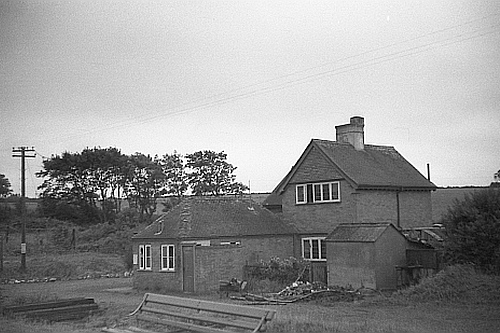
The station buildings at Combpyne, taken from a passing train. On the far side of a very grassy platform was the loop, removed in 1930, and beyond that a siding that was taken out of use in 1960. These buildings were slightly unusual in their situation in that they were set back from the line with some distance bewteen them and the platform, which in turn was the other side of the loop road/siding. photograph by Chris Knowles-Thomas
There was just one notable feature on the line and that was Cannington Viaduct. This was up to 93 feet above the ground below, 203 yards long and with ten arches, the lowest of which was some 53 feet high. photograph by Gregory Beecroft
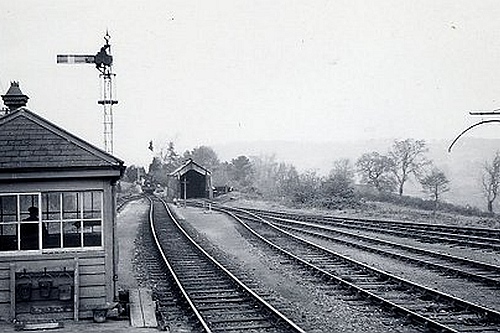
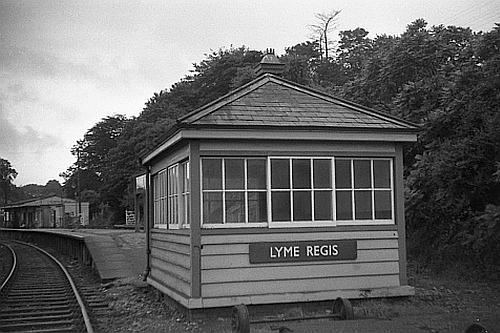
A view of the Lyme Regis Signalbox which was just off the platform, before the track alterations of 1960. photograph by Terry Heeley
A similar view of the ex-Signalbox showing how the track layout had been rationalised by this time. No longer in use for that purpose now the line has been reduced to one engine in steam operation. photograph by Chris Knowles-Thomas
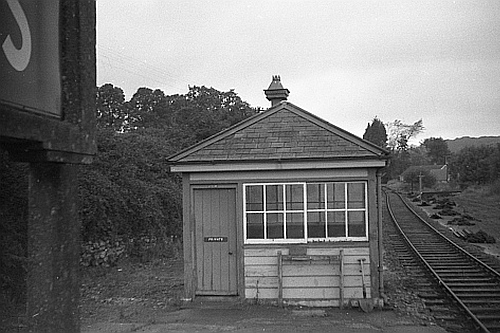
The view of the now ex-Signalbox as it was in 1965, with the station beyond. The road to the cattle dock ran behind the 'box, before it was lifted, as can just be seen in the photograph two above. photograph by Chris Knowles-Thomas
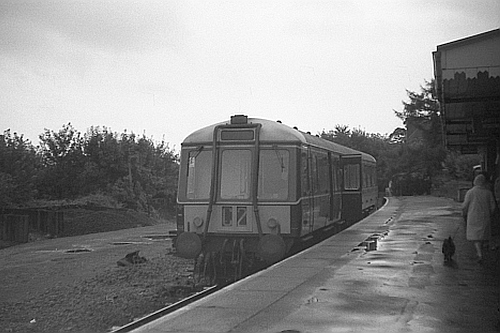
The single unit diesel railcar in the platform with no destination showing on its blind. The trackwork by 1965 had been severely reduced as there had previously been a run-round loop and three sidings on the empty ground beyond this train. photograph by Chris Knowles-Thomas
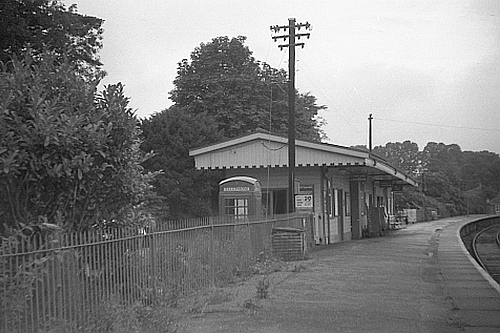
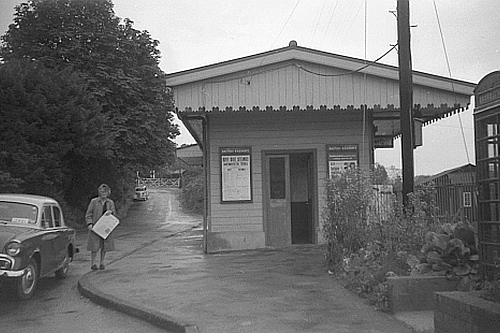
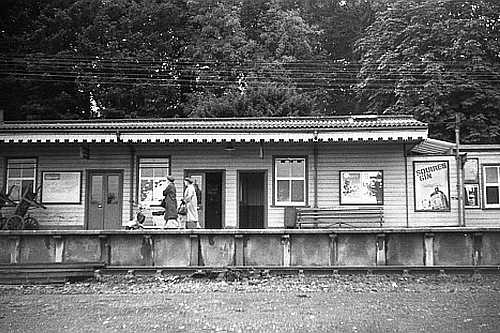
The station building at Lyme Regis as photographed from the road in September 1965. photograph by Chris Knowles-Thomas
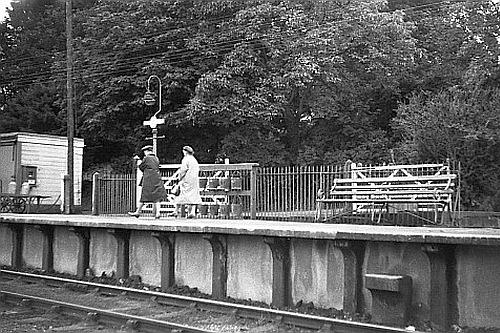
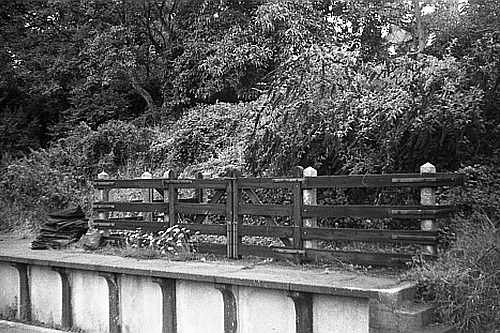
The platform showing off to good effect some of the produce of the Southern Railway's concrete works at Exmouth Junction. photograph by Chris Knowles-Thomas
Another view of the station building which also shows the flat, empty land where once had been a run-round loop and sidings. photograph by Chris Knowles-Thomas
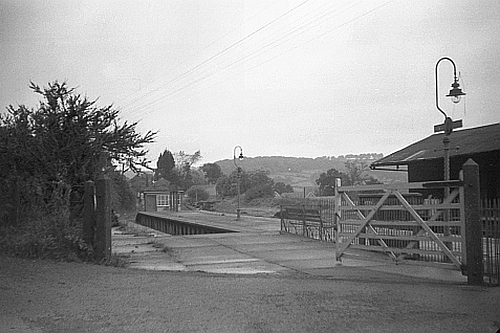
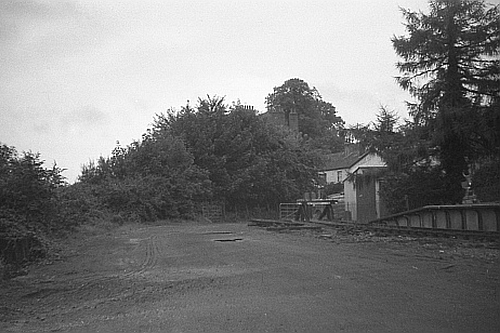
The view looking through the gate to the cattle dock, now deprived of any track, with the ex-Signalbox on view at the end of the platform. The engine shed had been further from the station to the right of the line. photograph by Chris Knowles-Thomas
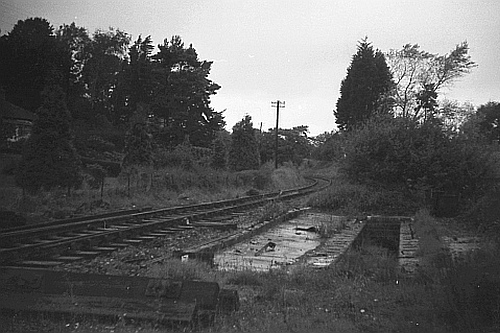
The cattle dock, still in reasonable condition even though it was no longer served by a siding. photograph by Chris Knowles-Thomas
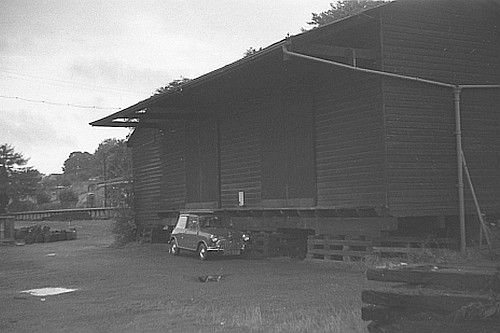
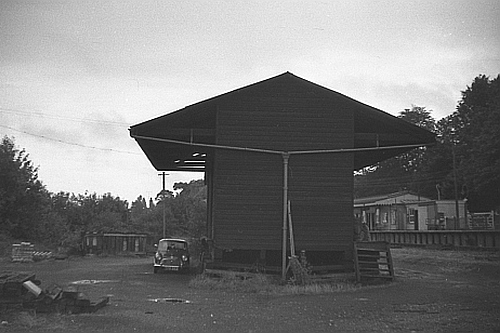
The goods shed was still in use in 1965, but not for its intended purpose. Before they were lifted there were sidings on either side of this building. Road access then had been from the far end. photograph by Chris Knowles-Thomas
The end-on view of the goods shed showing the large overhang of the roof which would have extended across the stock in the sidings on either side. photograph by Chris Knowles-Thomas
All that remained in 1965 of the engine shed. This wasn't the original as that, a wooden building, had burnt down shortly after the L&SWR took control of the line. Fortunately the locomotive crew, alert to the danger, had moved the engine out to safety. The shed was replaced a few months later. photograph by Chris Knowles-Thomas
The end of the line, and a rather sorry sight it was too. This area had been bustling with railway activity in previous years. photograph by Chris Knowles-Thomas
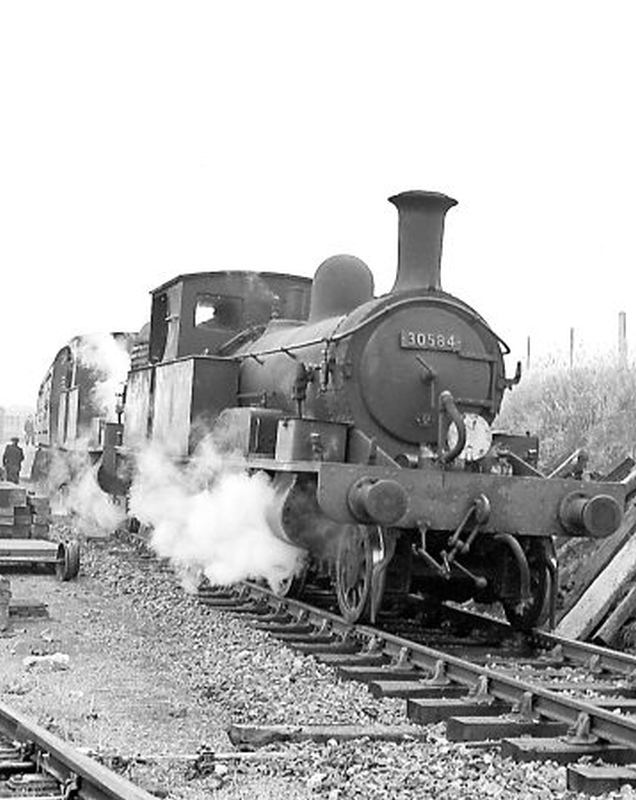
No account of the Lyme Regis branch would be complete without mention of its three antique Adams radial 4-4-2T engines. In a similar manner to the long-lasting Beattie Well Tanks at Wadebridge, these three survivors were kept at Exmouth Junction purely for working the Lyme Regis branch as, on account of its sharp radius curves, no other locomotive tried on the branch had been successful. When the line first opened two LB&SCR Terrier class 0-6-0T locos had been bought to work it but despite their short wheelbase they spread the track, lightly constructed with flat bottom rail spiked directly to the sleepers, out of gauge. When the radials were finally retired much of the track had to be relaid in 1960 to allow ex-LMS 2-6-2T locos to work the line. Three years later steam power was withdrawn! In this photo the 10:45am ex-Waterloo has paused briefly at Combpyne, in the charge of 4-4-2Ts 30583 and 30584. This was a regular double-headed turn on summer Saturdays and was photographed on 25th June 1960. photograph: Mike Morant collection |



This page was created 12 May 2010